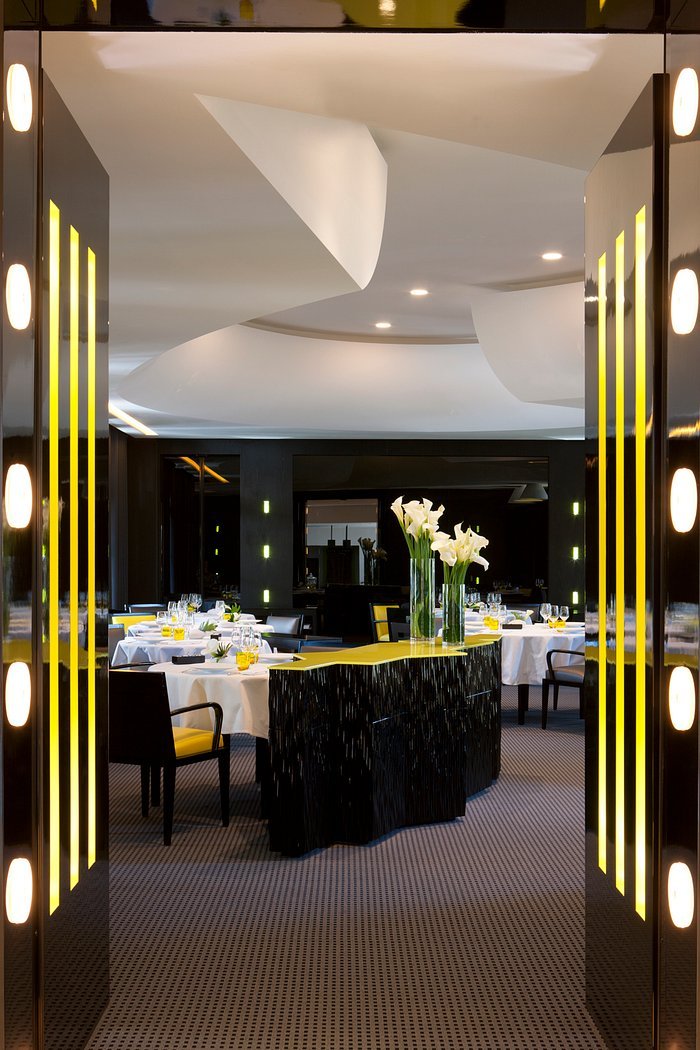
Restaurant
La Pyramide - Maison Henriroux
In Vienne, a Rhône Valley town 30 kilometres south of Lyon, La Pyramide carries one of French gastronomy's most significant addresses: the former house of Fernand Point, the chef who trained a generation that defined postwar French cooking. Today, under two Michelin stars and holding 91 points on La Liste 2026, the restaurant operates as a family-run maison with a seasonal, vegetable-forward approach and a cellar that includes a rare Chartreuse collection.
- 2 Michelin Stars
At a glance
- Cuisine
- Modern French Gastronomique
- Price
- $$$$
- Per person
- $110
- Neighborhood
- Vienne
- Rating
- 4.7 (1,594)
<h2>A House With a Long Memory</h2><p>There is a particular quality to entering a room where the walls have absorbed a century of serious cooking. At 14 Boulevard Fernand Point in Vienne, the building itself does the first round of communication before a dish arrives. The house was the home and restaurant of Fernand Point, the mid-20th-century figure whose kitchen produced Paul Bocuse, the Troisgros brothers, and Alain Chapel, among others. That generation, in turn, shaped the course of French haute cuisine across the latter half of the 20th century. The weight of that lineage is not merely decorative here: it is structural, the kind of history that defines what a table at La Pyramide actually means in the context of French dining culture.</p><p>Vienne sits on the Rhône, 30 kilometres south of Lyon, close enough to draw from that city's extraordinary supply infrastructure but far enough to hold its own provincial character. The town's Roman amphitheatre and first-century Temple of Augustus and Livia give the streets a particular register, one that the restaurant mirrors in its own relationship with the past. This is not nostalgia tourism, however. The kitchen has moved forward under its own terms, earning and maintaining two Michelin stars while establishing a vegetable-forward identity that connects to one of the more significant shifts in French fine dining over the past two decades.</p><h2>Where French Gastronomy Built Itself</h2><p>To understand La Pyramide's position in the French restaurant order, it helps to hold the full map. The Rhône corridor has been one of the most productive axes in European gastronomy. Lyon remains the reference city, with its bouchon culture at street level and a concentration of starred restaurants in the broader region that few French cities outside Paris can rival. The houses that shaped postwar cooking were not urban institutions but provincial ones: [Troisgros - Le Bois sans Feuilles in Ouches](https://www.enprimeurclub.com/restaurants/troisgros-le-bois-sans-feuilles-ouches-restaurant), [Paul Bocuse - L'Auberge du Pont de Collonges in Collonges-au-Mont-d'Or](https://www.enprimeurclub.com/restaurants/paul-bocuse-lauberge-du-pont-de-collonges-collonges-au-mont-dor-restaurant), [Bras in Laguiole](https://www.enprimeurclub.com/restaurants/bras-laguiole-restaurant), [Auberge de l'Ill in Illhaeusern](https://www.enprimeurclub.com/restaurants/auberge-de-lill-illhaeusern-restaurant). La Pyramide belongs to this lineage: a destination restaurant in a provincial town, where the journey is part of the visit's meaning.</p><p>At the national level, the French fine dining field has split between Paris-centric creative programs (see [Alléno Paris au Pavillon Ledoyen in Paris](https://www.enprimeurclub.com/restaurants/alleno-paris-au-pavillon-ledoyen-paris-restaurant)) and regionally rooted houses that draw their identity from place, seasonal supply, and accumulated reputation. La Pyramide sits firmly in the latter category. Its Opinionated About Dining Classical Europe ranking of #167 (2025), up from #182 in 2024, places it inside the recognised tier of French classical houses operating with sustained critical attention. La Liste awarded 91 points in 2026, consistent with the 92 points it held in 2025, signalling a house that scores at the upper end of the two-star bracket without the volatility that can accompany more experimental formats.</p><p>For comparison against the highest-rated modern French programs, tables at [Mirazur in Menton](https://www.enprimeurclub.com/restaurants/mirazur-menton-restaurant), [Flocons de Sel in Megève](https://www.enprimeurclub.com/restaurants/flocons-de-sel-megeve-restaurant), and [AM par Alexandre Mazzia in Marseille](https://www.enprimeurclub.com/restaurants/am-par-alexandre-mazzia-marseille-restaurant) represent different interpretive frameworks. La Pyramide's approach is classical in structure but not static: its vegetable integration and seasonal producer network represent a deliberate positioning within the mainstream of serious French cooking today, rather than a reactionary defence of tradition.</p><h2>The Kitchen's Particular Language</h2><p>The awards record specifically notes that the kitchen has retained part of what was built under Fernand Point while also developing a cuisine that is described as strongly vegetable-forward. This dual orientation is worth holding together. Preserving the physical kitchen and certain culinary continuities from Point's era is a deliberate act of cultural stewardship; grafting a seasonal, producer-led vegetable program onto that foundation reflects the direction French haute cuisine has moved since Michel Bras formalized that approach at his Aubrac table in the 1990s.</p><p>The producer network supplying the kitchen is described as local and seasonal, which in the Rhône Valley means access to one of the most productive agricultural regions in France: stone fruits from the Drôme, early spring vegetables from the Isère flatlands, and the proximity to Alpine forage territory. Chef Julien Roucheteau leads the kitchen today. The house operates under the Relais & Châteaux affiliation, which for restaurants typically signals a minimum standard of service formality, accommodation linkage, and a commitment to the kind of extended, unhurried meal format that allows the kitchen to express itself fully across multiple courses.</p><p>Chartreuse cellar is a separate, documented point of interest. Chartreuse, the liqueur produced by Carthusian monks in the Chartreuse mountains east of Grenoble, is notoriously difficult to cellar in depth: production is controlled, allocation is limited, and aged expressions are rarely encountered outside specialist collections. A dedicated Chartreuse cellar at a Rhône Valley table is not incidental detail but a genuine indicator of how seriously the house approaches its regional identity and its relationship with the broader gastronomic culture of the area between Lyon and Grenoble.</p><h2>A Family-Run House in the French Provincial Tradition</h2><p>Family-run designation matters in this context. The €€€€ price tier in a family-operated provincial restaurant implies a different business logic than the same price tier at a Paris hotel restaurant. There are no parent-company revenue targets here, no corporate F&B; strategy. The economic calculus of maintaining a two-star operation in Vienne is specific to the family that runs it, which tends to produce a different relationship between kitchen and dining room than is common in institutionally backed houses. This is a pattern observable across many of France's most durable provincial restaurants, from [Assiette Champenoise in Reims](https://www.enprimeurclub.com/restaurants/assiette-champenoise-reims-restaurant) to [Auberge de l'Ill in Illhaeusern](https://www.enprimeurclub.com/restaurants/auberge-de-lill-illhaeusern-restaurant).</p><p>Google ratings from over 1,500 reviews average 4.7 out of 5, which at this volume represents a statistically meaningful signal. High-end French restaurants often generate polarised scores at volume; a 4.7 across 1,558 reviews suggests a consistent guest experience rather than one dependent on exceptional individual service moments.</p><h2>Vienne Beyond the Table</h2><p>A visit to La Pyramide operates as an anchor for a Vienne trip rather than a standalone meal. The Roman theatre, the Musée des Beaux-Arts et d'Archéologie, and the town's position on the Rhône cycling route provide a full day's context around the meal. The proximity to Lyon (a 30-minute TGV or 45-minute drive) means the visit integrates naturally into a broader Rhône itinerary rather than requiring Vienne as a dedicated destination stay. For those building a longer programme, [our full Vienne restaurants guide](https://www.enprimeurclub.com/restaurants/vienne) maps the broader dining scene, and [our full Vienne hotels guide](https://www.enprimeurclub.com/hotels/vienne) covers accommodation options in and around the town. Further local context is available through [our full Vienne bars guide](https://www.enprimeurclub.com/bars/vienne), [our full Vienne wineries guide](https://www.enprimeurclub.com/wineries/vienne), and [our full Vienne experiences guide](https://www.enprimeurclub.com/experiences/vienne).</p><p>For those exploring similar registers in the Vienne dining scene, [L'Espace PH3](https://www.enprimeurclub.com/restaurants/lespace-ph3-vienne-restaurant) and [Alquimia (Creative)](https://www.enprimeurclub.com/restaurants/alquimia-vienne-restaurant) offer points of comparison at different formats and price positions.</p><h2>Planning a Visit</h2><p>The restaurant is at 14 Boulevard Fernand Point, Vienne, reachable by train from Lyon Part-Dieu in under 30 minutes. The Relais & Châteaux affiliation confirms on-site accommodation, so an overnight stay is viable and eliminates the timing pressure of last-train returns to Lyon. Reservations should be made through the restaurant directly at lapyramide.com or via pyramide@relaischateaux.com. At the €€€€ price tier with two Michelin stars and sustained La Liste recognition, advance booking of several weeks at minimum is advisable, particularly for weekend lunch or dinner. The house has been a Relais & Châteaux member, which means the booking infrastructure is handled to the standards expected of that network.</p><p>For broader French fine dining context and international comparisons in the modern cuisine category, [Frantzén in Stockholm](https://www.enprimeurclub.com/restaurants/frantzen-stockholm-restaurant) and [FZN by Björn Frantzén in Dubai](https://www.enprimeurclub.com/restaurants/fzn-by-bjorn-frantzen-dubai-restaurant) represent the range of how the format travels across different markets.</p><h2>Frequently Asked Questions</h2><dl><dt><strong>Is La Pyramide - Maison Henriroux a family-friendly restaurant?</strong></dt><dd>At the €€€€ price tier in Vienne, La Pyramide operates as a formal fine dining experience: multi-course, unhurried, and structured around an adult dining occasion. It is not a setting designed around young children.</dd><dt><strong>What's the overall feel of La Pyramide - Maison Henriroux?</strong></dt><dd>This is a provincial French maison in the classical tradition: formal without being stiff, rooted in place and history, and operating with the quiet confidence that two Michelin stars and a La Liste score of 91 (2026) produce. In Vienne, it remains the reference address for serious French dining at this level, and the Relais & Châteaux affiliation signals a service standard consistent with that positioning.</dd><dt><strong>What's the signature dish at La Pyramide - Maison Henriroux?</strong></dt><dd>The kitchen does not publicise a fixed signature dish, and specific menu items are not confirmed in available records. What the awards documentation makes clear is that the cuisine under Chef Julien Roucheteau is vegetable-forward and seasonally driven, drawing from a local producer network: the character of the cooking is more usefully understood through that framework than through any single plate. For a house holding two Michelin stars with a Classical Europe OAD ranking of #167, the full menu is the unit of meaning.</dd></dl>
Know before you go
- Dress code
- formal
- Reservations
- essential
- Parking
- on_site_lot
- Payment
- credit_card
- Accessibility
- wheelchair_accessible, accessible_parking
- Outdoor seating
- Yes
- Groups
- Welcomed
Frequently asked
Is La Pyramide - Maison Henriroux a family-friendly restaurant?
La Pyramide is a family-run house in the French provincial tradition, which typically means a composed, formal dining room rather than a setting designed around young children. At the €€€€ price tier with two Michelin stars, the experience is calibrated for guests who will engage with the full sequence of a serious tasting menu. Families with older children comfortable in that setting will find the staff attentive; families with toddlers would likely be better served elsewhere in Vienne.
What's the overall feel of La Pyramide - Maison Henriroux?
The address at 14 Boulevard Fernand Point carries genuine historical weight: this is the house where Fernand Point ran the restaurant that trained much of post-war French gastronomy. Under Patrick Henriroux and now with chef Julien Roucheteau, the rooms retain that sense of accumulated seriousness without feeling like a museum. The Relais & Châteaux affiliation, two Michelin stars, and a 92-point La Liste score (2025) place it firmly in the upper tier of French provincial dining, with a kitchen that has developed a notably vegetable-forward identity alongside its classical foundations.
What's La Pyramide - Maison Henriroux known for in terms of accolades?
La Pyramide - Maison Henriroux has received recognition including: La Liste Top Restaurants (2026): 91pts; In the old house of Fernand Point, Patrick Henriroux, with two Michelin stars on his record, has retained part of the kitchen of his illustrious predecessor, but has also left his own mark on a delici….
What's the signature dish at La Pyramide - Maison Henriroux?
Specific current menu items are not published in available reference data for La Pyramide. What the awards record does confirm is that the kitchen has built its identity around seasonal vegetables sourced from a network of small local producers, while retaining techniques associated with the Point era. For current dishes, the restaurant's direct contact is pyramide@relaischateaux.com or +33 (0)4 74 53 01 96.
What's the cuisine at La Pyramide - Maison Henriroux?
La Pyramide - Maison Henriroux is categorized in our database as Modern Cuisine.
Address
14 Bd Fernand Point, 38200 Vienne, France
Vienne
How it compares
La Pyramide - Maison Henriroux
- Cuisine
- Modern Cuisine
- Awards
- La Liste Top Restaurants (2026): 91pts; In the old house of Fernand Point, Patrick Henriroux, with two Michelin stars on his record, has retained part of the kitchen of his illustrious predecessor, but has also left his own mark on a delicious cuisine that is also very vegetable. For this he has provided a network of small local producers who supply him with fruit and vegetables of the season.; Opinionated About Dining Classical in Europe Ranked #167 (2025); HIGHLIGHTS: • 2 MICHELIN STARS 2025 • A FRENCH DINING ICON • FAMILY-RUN • UNIQUE CHARTREUSE CELLAR DIRECTIONS & ACCESS: Website and contact information E-mail: pyramide@relaischateaux.com Tel. : +33 (0)4 74 53 01 96 MEMBER SINCE: 4.8/5; La Liste Top Restaurants (2025): 92pts; Michelin 2 Stars (2025); Opinionated About Dining Classical in Europe Ranked #182 (2024); Michelin 2 Stars (2024); Opinionated About Dining Classical in Europe Highly Recommended (2023)
- Notes
- This venue
Alléno Paris au Pavillon Ledoyen
- Cuisine
- Creative
- Awards
- Michelin 3 Star, World's 50 Best
- Notes
- Creative, €€€€
- Cuisine
- Contemporary French, Modern Cuisine
- Awards
- Michelin 3 Star, World's 50 Best
- Notes
- Contemporary French, Modern Cuisine, €€€€
- Cuisine
- French, Classic Cuisine
- Awards
- Michelin 3 Star, World's 50 Best
- Notes
- French, Classic Cuisine, €€€€
Le Cinq - Four Seasons Hôtel George V
- Cuisine
- French, Modern Cuisine
- Awards
- Michelin 3 Star, World's 50 Best
- Notes
- French, Modern Cuisine, €€€€
- Cuisine
- Contemporary French
- Awards
- Michelin 3 Star, World's 50 Best
- Notes
- Contemporary French, €€€€
In residence
Similar places
Modern Chinese Fine Dining
Sazenka
Tokyo, Japan
★★★ · 50 Best
Sézanne
Tokyo, Japan
★★★ · 50 Best
Japanese-influenced Californian Kaiseki
Single Thread Farm
Healdsburg, United States
★★★ · 50 Best
French Seafood Fine Dining
Le Bernardin
New York City, United States
★★★ · 50 Best
Modern Korean Tasting Menu
Atomix
New York City, United States
★★ · 50 Best
Contemporary Plant-Based Fine Dining
Eleven Madison Park
New York City, United States
★★★ · 50 Best